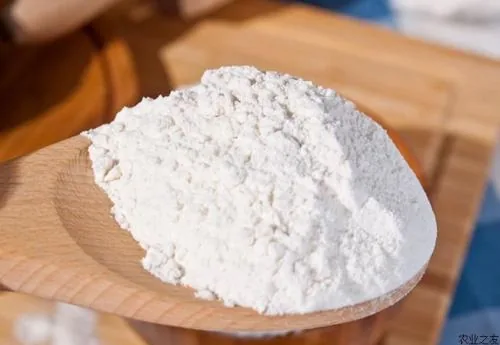
There are four ways to judge flour quality: look, smell, taste and feel.
Look: examine the colour. The colour of flour is the basis for grading it. Higher-grade flour is white, fine and even, free of off-colours and bran specks; lower-grade flour is inferior on these points. Flour that is cream-coloured or pale yellow generally contains more hard wheat and tends to have a higher gluten content.
Smell: good flour has a wheaty aroma, whereas flour that has been over-heated or stored too long takes on an off odour from grain ageing and feels sticky to the taste. If your sense of smell is keen, take a little flour and smell it directly; if not, stir the flour into hot water and smell. A scent of straw and wheat means the flour was milled recently, is of good quality and has not had excessive additives. A strong dusty smell means it is old flour or has had too much added.
Taste: put a little dry flour in your mouth. A gritty feel means a high sand content; a sour taste means high acidity. When tasting it cooked, normal flour has a pleasant “starchy” finish and a fine texture; a gritty mouthfeel again means high sand content.
Feel: grab a handful and squeeze firmly. If the flour is powdery and not granular, and falls loose without clumping when you open your hand, its moisture content is about right. If it readily forms a ball, clumps and feels sticky, the moisture content is high, and in warm, humid weather it will be prone to heating up, going mouldy and spoiling. Good flour feels soft when rubbed; if it feels excessively smooth, something is wrong.
A note of caution: “Diaobaikuai” (sodium formaldehyde sulfoxylate) is a strongly reducing chemical at high temperature with a bleaching effect. Its aqueous solution begins to break down above 60°C, and below 120°C decomposes into formaldehyde, carbon dioxide, hydrogen sulfide and other toxic gases. These gases can cause headache, fatigue and poor appetite; long-term exposure to formaldehyde markedly raises the risk of tumours and cancer in the nasal cavity and nasopharynx. Diaobaikuai is not a food additive — it is used mainly as a stripping agent in the printing-and-dyeing industry.