
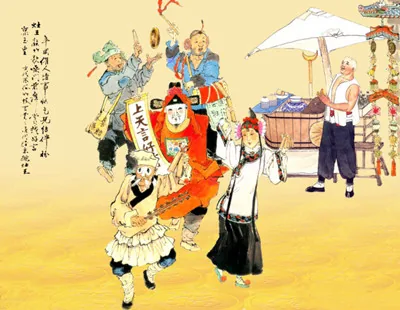
“Little New Year” (Xiaonian) does not refer to a single fixed festival; because customs differ by region, the day called Little New Year is not the same everywhere. Its main folk activities include pasting Spring Festival couplets, sweeping away dust, and honouring the Kitchen God.
Little New Year also means people begin to prepare New Year goods and clean the house thoroughly for a good year — signifying that the new year should bring a new spirit, and expressing the working people’s wish to bid farewell to the old and welcome the new, inviting good fortune.
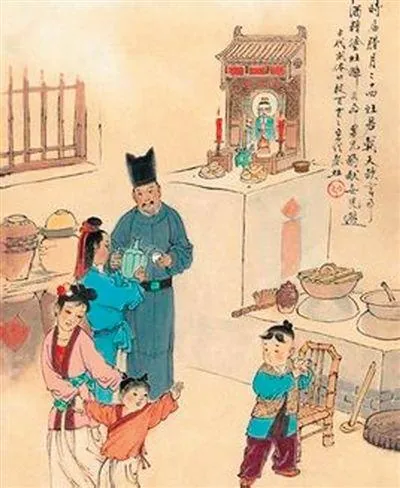
The night of the 23rd of the twelfth lunar month is when the Kitchen God ascends to heaven — hence the saying “on the 23rd, honour the Kitchen God,” and the couplet “speak well of us in heaven, return to bless us; leave on the 23rd, come back at dawn on the 1st.” On this day, or earlier, every household buys “Kitchen-God candy” made specially of corn or millet and offers it in the evening — the idea being to “glue up” the Kitchen God’s mouth so he cannot report wrongly in heaven — while setting off firecrackers to send the god off. The offered candy is then usually kneaded together with parched corn into balls and shared among the family’s children and adults. By tradition, the Kitchen-God day is the prelude to the New Year, captured in a long-standing rhyme counting down the days: “on the 21st, send off the daughter; the 22nd…; the 23rd, honour the Kitchen God; the 24th, sweep away the dust; the 25th, mix coal; the 26th, cut the meat; the 27th, go to market; the 28th, steam the New Year buns; the 29th, fetch the wine; the 30th, paste a chubby-child picture on the wall; on the 1st, bow in greeting.”
The custom of honouring the Kitchen God is in fact ancient. The Book of Rites records the rite of sacrificing to the stove, listed then among the “five sacrifices.” A Warring-States text records someone saying “I once dreamt I saw the Kitchen God,” and the Tang poet Luo Yin’s poem on sending off the Kitchen God has the famous lines, “a cup of clear tea, a wisp of smoke; the Kitchen God ascends to the blue heaven.” Clearly the rite existed more than two thousand years ago and has been handed down through the dynasties.
The prelude to Spring Festival is the “Kitchen-God offering” on the 23rd of the twelfth month, which in ancient times ranked second only to Mid-Autumn. Officials, merchants and scholars away from home would hurry back before this day to reunite and eat the family’s home-made Kitchen-God candy, praying for the god’s blessing and a peaceful year ahead. The Song poet Fan Chengda’s “Ode to Honouring the Kitchen God” describes the day in vivid, affectionate detail, showing how much the ancients valued the rite and how plentiful the offerings of food were.