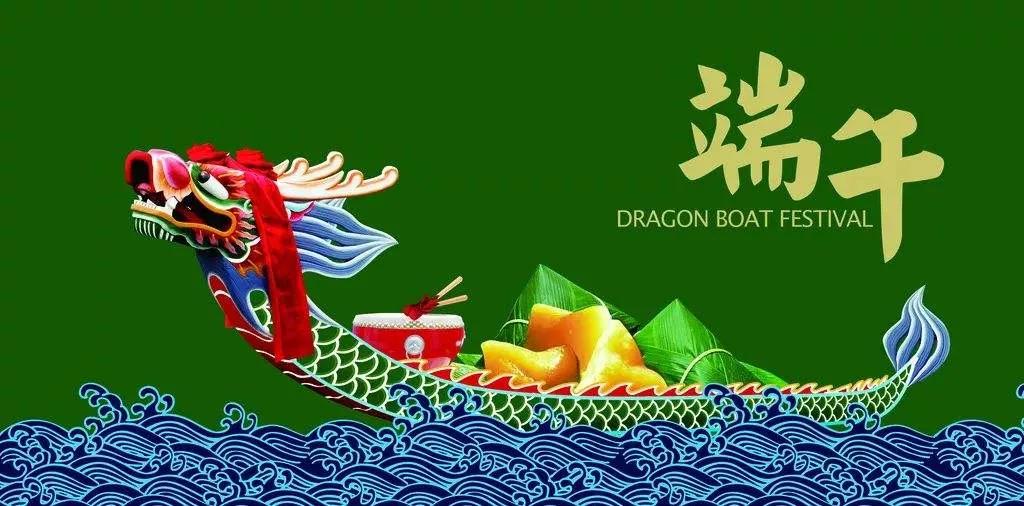
The Dragon Boat Festival falls on the fifth day of the fifth lunar month, also called Duanyang, the Noon Festival or the Fifth-Month Festival. It is one of China’s official public holidays and has been inscribed on the world list of intangible cultural heritage. Originating in China, it began as a festival for warding off illness and pestilence; before the Spring and Autumn period, the Wu and Yue lands held dragon-boat racing as a totem sacrifice on the fifth of the fifth month. Later, because the poet Qu Yuan died on this day, it became the traditional festival on which the Han Chinese commemorate him; in some regions it is also said to commemorate Wu Zixu or Cao E. Its customs include eating zongzi (rice dumplings), drinking realgar wine, hanging calamus and mugwort, and dragon-boat racing.
According to the Records of the Grand Historian, Qu Yuan was a minister of King Huai of Chu in the Spring and Autumn period. He advocated promoting the able and worthy, enriching the state and strengthening its army, and allying with Qi to resist Qin — drawing fierce opposition from aristocrats such as Zilan. Slandered and dismissed, he was driven from the capital and exiled to the Yuan and Xiang river region. In exile he wrote the immortal poems Li Sao, Tian Wen and Jiu Ge, of singular style and far-reaching influence (which is why the festival is also called the Poets’ Festival). In 278 BC the Qin army broke through the Chu capital. Watching his homeland invaded, Qu Yuan was heartbroken yet could not bear to abandon his country; on the fifth of the fifth month, after writing his final work Huai Sha, he clasped a stone and drowned himself in the Miluo River, composing with his own life a magnificent anthem of patriotism.
It is said that after Qu Yuan’s death the people of Chu mourned deeply and rushed to the Miluo River to pay their respects. Fishermen rowed back and forth searching for his body. One brought out rice balls, eggs and other food prepared for Qu Yuan and threw them into the river, so that the fish, dragons, prawns and crabs would eat their fill and not bite his body; seeing this, others followed suit. An old physician poured a jar of realgar wine into the river to stupefy the water-dragons and beasts so they would not harm him. Later, fearing the rice balls would be eaten by the dragons, people wrapped the rice in chinaberry leaves bound with coloured thread — which developed into zongzi.
Thereafter, on the fifth of the fifth month each year, the customs of dragon-boat racing, eating zongzi and drinking realgar wine arose, to commemorate the patriotic poet Qu Yuan.
The Tang emperor Li Longji wrote a poem, “Dragon Boat Festival,” and the Song poet Su Shi too returned again and again to the festival in his verse — both celebrating the season, its calamus and mugwort at the door, the fragrance of zongzi leaves, the racing of dragon boats, and remembrance of Qu Yuan.
On festive greetings, most folklorists hold that the festival came first, and figures such as Qu Yuan were later attached to it to give it sacrificial or other meanings — meanings that are only part of the festival, which was founded as a joyful occasion. The word “ankang” (peace and good health) is, in everyday use, generally a greeting offered to the elderly; “Duanwu ankang” has no basis in the historical records and only began to circulate in recent years. Many ancient poems speak of celebrating the Dragon Boat Festival joyfully, so wishing a “happy Dragon Boat Festival” is in fact the traditional greeting.